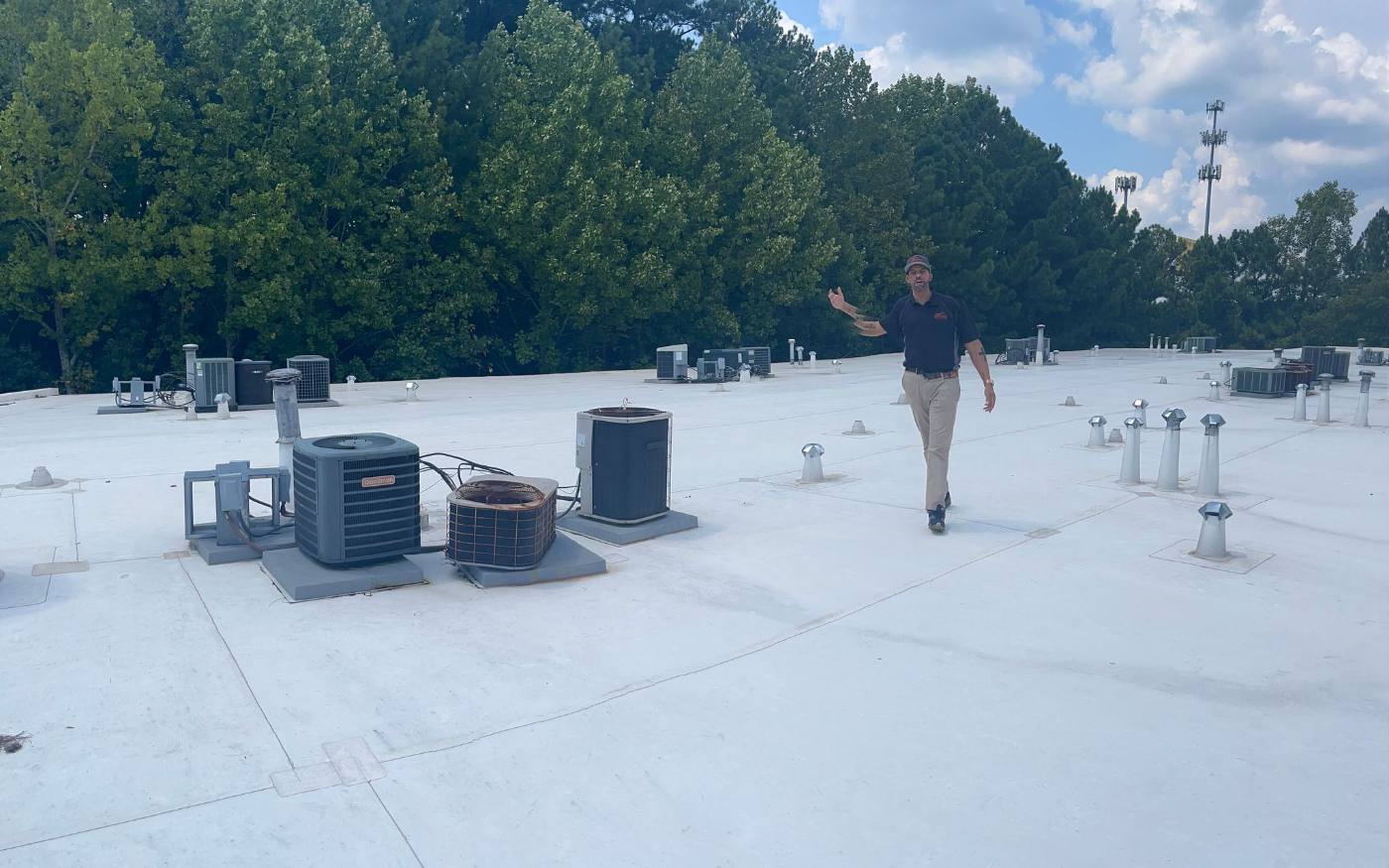
If you own or manage a building with a flat or low-slope roof in metro Atlanta, the two membranes you'll hear about most are TPO and PVC. From the parking lot they look almost identical: white, smooth and heat-welded. Underneath, they're different materials with different strengths.
We install both. Our TPO roofs use GAF EverGuard 60-mil membrane, and as a Duro-Last Authorized Dealer we install factory-prefabricated Duro-Last PVC. Here's how we help owners choose.
What they have in common.
- Single-ply membranes, installed in large sheets over insulation and cover board.
- Heat-welded seams. Hot air fuses overlapping sheets into one continuous membrane. Welded seams are far stronger than the taped or glued seams on older EPDM rubber roofs.
- White, reflective surfaces that keep the roof cooler in Atlanta summers and can reduce the load on rooftop units.
- Typical service life of 20 to 30 years when installed and maintained correctly.
Where TPO wins.
TPO (thermoplastic polyolefin) is the most widely installed commercial membrane in the country for a reason.
- Value. TPO usually costs less than PVC for the same roof.
- Flexibility in system design. It can be fully adhered or mechanically attached, over tapered insulation that moves water to drains.
- Strong warranties. Our 60-mil GAF EverGuard TPO roofs carry a 20-year GAF material warranty plus Mosaic's 10-year workmanship warranty.
TPO is the right call for most offices, warehouses, retail, churches, apartment buildings and residential flat roofs.
Where PVC earns its price.
PVC (polyvinyl chloride) has been on commercial roofs for decades, and it shines in specific situations.
- Grease and chemicals. PVC resists animal fats, cooking oils and many chemicals. Restaurant exhaust fans put grease on the roof, and that grease breaks down other membranes over time. For restaurants and food processing, PVC is usually the better roof.
- Fewer field seams with Duro-Last. Duro-Last custom-fabricates the membrane in its factory from measurements of your roof. Most seams are welded in the factory, along with flashings for curbs, stacks and corners. Fewer seams on the roof means fewer places for a leak to start.
- Complex roofs. Roofs crowded with HVAC units, vents and penetrations benefit from prefabricated flashings.
- Overlays. On many existing flat roofs, a Duro-Last membrane can go right over the old roof once we confirm it's dry, avoiding tear-off and keeping the building open.
Side by side.
- Cost: TPO is usually lower. PVC is higher.
- Grease and chemical resistance: PVC is clearly better. TPO is not recommended where grease reaches the roof.
- Seams: both are heat-welded. Duro-Last PVC has most seams welded in the factory.
- Lifespan: both commonly 20 to 30 years with maintenance.
- Best for: TPO for most buildings. PVC for restaurants, chemical exposure, complex roofs and overlays.
What matters more than the membrane.
Most flat-roof failures don't happen because someone picked the wrong membrane. They happen at the details.
- Drainage. Ponding water is the number one enemy of flat roofs. On replacements we design tapered insulation that moves water to drains and scuppers.
- Wet insulation. Putting a new membrane over wet insulation traps the problem. We check with core cuts or a moisture survey before recommending a recover or overlay.
- Flashings. Walls, curbs, drains and penetrations are where leaks start. They need to be welded and terminated correctly.
- Maintenance. A twice-a-year inspection with drain and seam checks is the cheapest way to make any flat roof reach its full life.
Recover, overlay or tear off?
If your existing roof is dry and structurally sound with no more than one existing layer, a new membrane can often go over it. That saves tear-off cost and disruption. If the insulation is saturated, it has to come off. We'll show you core results and photos so the decision is based on evidence, not a guess.
If your roof is aging but still dry, a roof coating like an ASTEC restoration may be another option. See our post on roof coating vs. roof replacement.
Which one should you choose?
- Office, warehouse, church, retail or apartments: TPO is usually the best value.
- Restaurant or kitchen exhaust on the roof: PVC, almost every time.
- Lots of rooftop equipment, or you want an overlay without tear-off: Duro-Last PVC is worth pricing.
- Residential porch, addition or modern flat-roof home: either works. We often recommend TPO, or an 80-mil Duro-Last overlay on existing flat roofs.
We'll price both on the same proposal. Learn more about TPO roofing, Duro-Last PVC roofing and our commercial roofing services.
Is PVC better than TPO?
Not always. PVC is better where grease or chemicals reach the roof, like restaurants, and Duro-Last's factory-welded seams are a real advantage on complex roofs. For most other buildings, TPO is the better value.
How long does a TPO roof last?
A well-installed 60-mil TPO roof commonly lasts 20 to 30 years. Drainage and maintenance make a big difference.
Can a new flat roof go over my old one?
Often, if the existing roof and insulation are dry and there's no more than one existing layer. We test for moisture before recommending a recover.
Is Mosaic a Duro-Last dealer?
Yes. Mosaic Roofing Company is a Duro-Last Authorized Dealer serving metro Atlanta.
What warranty comes with a Mosaic TPO roof?
A 20-year GAF material warranty on 60-mil EverGuard TPO, plus Mosaic's 10-year workmanship warranty.