Copper is the most durable roofing metal there is. Properly installed, it routinely lasts 70 to 100 years or more, and it gets more beautiful as it ages. It's also the least forgiving metal to install. Every seam, cleat and solder joint is done by hand, and small mistakes show for decades.
Where copper is used.
Most copper on Atlanta homes is accent work over a shingle, slate or tile main roof:
- Bay windows and box bays
- Front entries and porch roofs
- Dormers
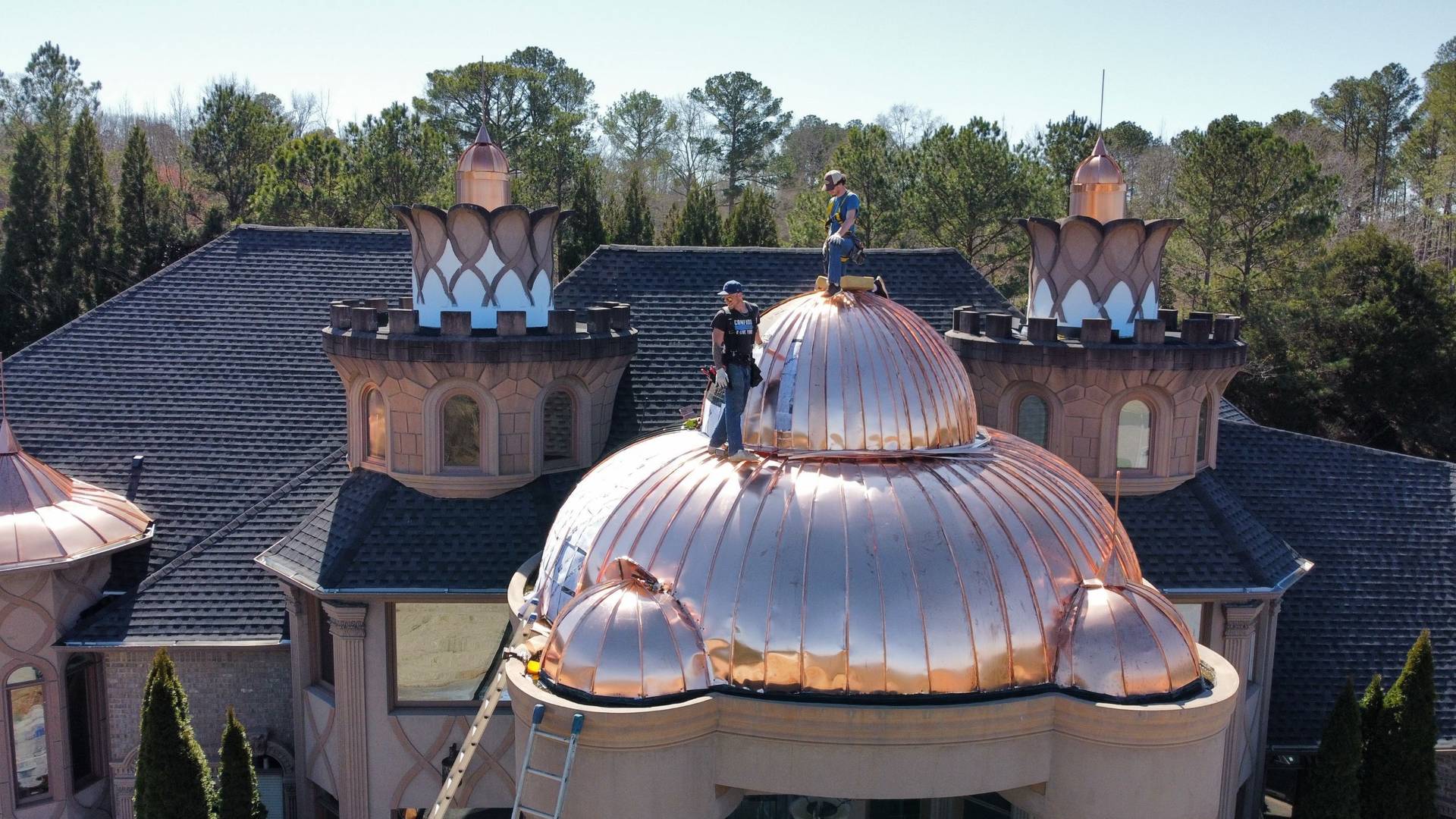
- Turrets, domes and cupolas
- Chimney caps and crickets
- Valleys, flashing and gutters
Full copper roofs are rarer, usually on historic and luxury homes. Accents alone can define the look of a house.
Standing seam vs. flat-lock.
- Standing seam copper uses raised seams that let panels expand and contract with temperature. It's the go-to for sloped bays, porches and domes.
- Flat-lock copper uses small interlocking, soldered panels and works on low-slope areas and complex curved shapes.
- Curved work, like domes and turrets, uses tapered panels cut and formed on site, seamed panel by panel so the lines run true from base to finial.
How patina develops.
New copper is bright and shiny. Within months it darkens to brown. Over many years, depending on rain, sun and exposure, it develops the blue-green patina people picture. In Atlanta's climate, that green layer can take a long time to form, and different sides of the house often age at different speeds.
The patina isn't damage. It's a protective layer that helps copper last as long as it does. Some homeowners prefer to keep copper brown; coatings and treatments can slow the change, though most people let it age naturally.
Why copper lasts.
- It doesn't rust.
- It's naturally resistant to corrosion, and the patina protects it further.
- It's soft enough to move with temperature without cracking when seams are designed for it.
- Joints can be re-soldered decades later.
What can go wrong.
- Galvanic corrosion. Copper reacts with steel and aluminum. Fasteners, flashing and gutters touching copper must be compatible, or the other metal corrodes.
- Poor expansion design. Long panels fastened too tightly can buckle or tear at seams.
- Runoff staining. Water from copper can stain stone, stucco and light-colored surfaces below. Good detailing directs it away.
- Inexperienced soldering. Weak solder joints leak.
Copper with slate, tile and metal.
Copper pairs naturally with natural slate, clay tile, Brava composite and standing seam. On many of the custom and historic homes we work on, copper valleys, chimney flashing and bay roofs go in alongside the main roof so the whole house is one coordinated system.
What to ask a copper roofer.
- Can I see photos of curved copper you've built yourselves?
- What gauge or weight of copper do you use?
- How do you handle expansion on long runs?
- What fasteners and underlayment go under the copper?
- Who does the soldering?
How Mosaic builds copper.
Our crew hand-forms copper domes, turrets, bays, dormers, porches and full roofs, cut and seamed on site. We build the underlayment and edge details first so the copper sheds water at every curve. See copper roofing, and our related work in slate and standing seam metal.
How long does copper roofing last?
Properly installed copper routinely lasts 70 to 100 years or more.
How long does it take copper to turn green?
It darkens to brown within months. The green patina develops over many years and depends on rain, sun and exposure.
Can you repair existing copper?
Yes, including re-soldering seams, replacing damaged panels and rebuilding flashing.
Can copper be used with other metals?
Only with compatible materials. Copper touching steel or aluminum causes galvanic corrosion, so fasteners, flashing and gutters need to be chosen carefully.